PLATO (Exoplanet Telescope)
Liftoff Time
No Earlier Than January, 2027
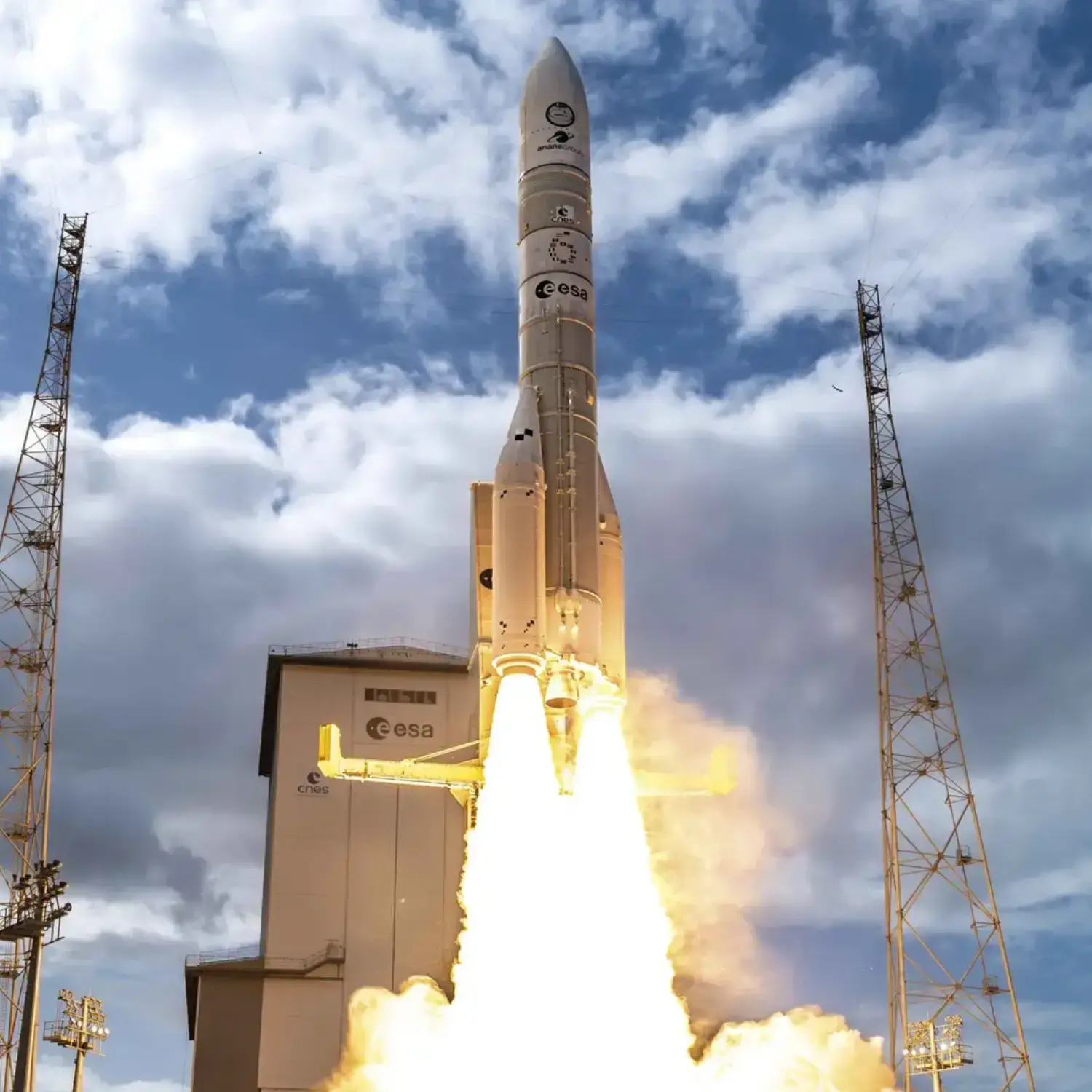

Mission Details
PLATO (Exoplanet Telescope)
PLAnetary Transits and Oscillations of stars (PLATO) is a space telescope under development by the European Space Agency. The mission goals are to search for planetary transits across up to one million stars and to discover and characterize rocky extrasolar planets around yellow dwarf stars (like our sun), subgiant stars, and red dwarf stars. The emphasis of the mission is on Earth-like planets in the habitable zone around sun-like stars where water can exist in a liquid state. It is the third medium-class mission in ESA's Cosmic Vision programme and is named after the influential Greek philosopher Plato, the founding figure of Western philosophy, science, and mathematics. A secondary objective of the mission is to study stellar oscillations or seismic activity in stars to measure stellar masses and evolution and to enable the precise characterization of the planet's host star, including its age.
Manufacturer: OHB
Operator: ESA
Sun–Earth L2
1 Payload
2,100 kilograms
HENON
Heliospheric Pioneer for Solar and Interplanetary Threats Defence (HENON) is a 12U XL CubeSat mission aimed at performing a demo of Space Weather measurements in Distant Retrograde Orbit (DRO) for 3-6 hour advanced warning of solar storms. The mission will be a demo of deep space CubeSat technologies, also performing a transfer from Sun-Earth L1/L2 to DRO using electric propulsion.
Manufacturer: Argotec
Operator: ESA
Sun–Earth L2
1 Payload